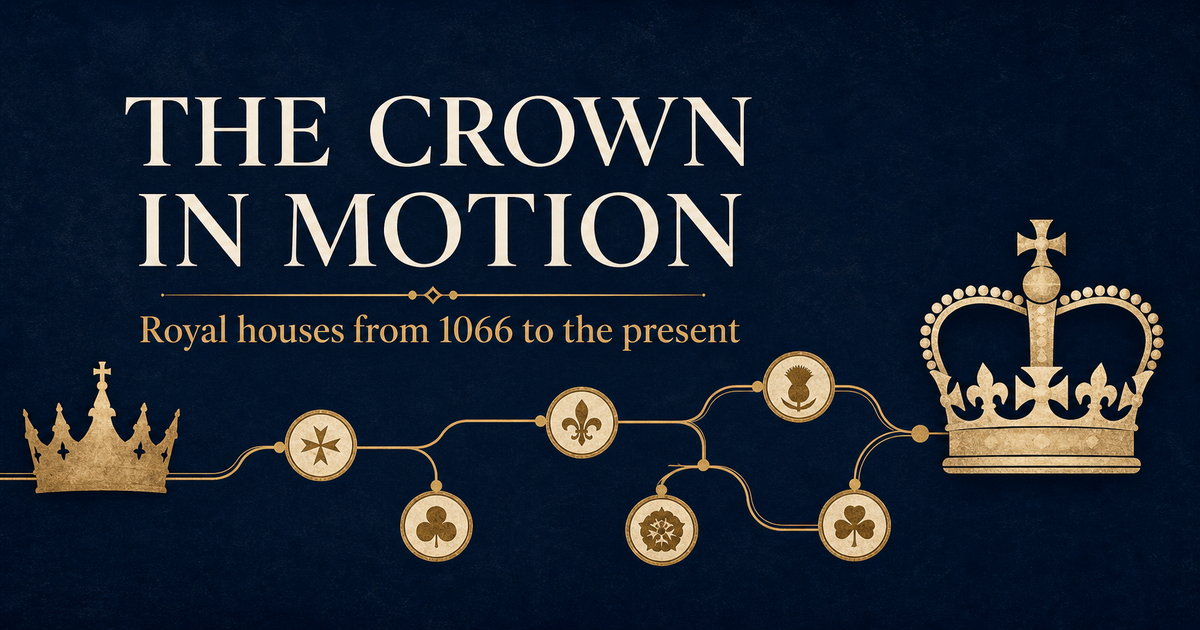
The Crown in Motion

Follow the family ties, rival claims and political upheavals that connect William the Conqueror to Charles III.

960 years of succession11 houses and branches

Interactive explorer

How the houses connect

Select a house to see its monarchs and how power passed into and out of the dynasty.

England1066–1707
Great Britain1707–1801
United Kingdom1801–present
InheritanceMarriageCadet branchConquestDepositionDynastic renamingContested claim
  1. Contested claim · Stephen bypasses Matilda
  2. Inheritance · Settlement brings Henry II
  3. Cadet branch · Lancaster breaks from the main line
  4. Deposition · York takes the crown
  5. Conquest · Bosworth begins Tudor rule
  6. Inheritance · Stuart inherits through Margaret Tudor
  7. Marriage · Orange-Nassau overlaps, 1689–1702
  8. Inheritance · Anne continues Stuart rule; Hanover follows
  9. Marriage · Victoria's son takes his father's house
  10. Dynastic renaming · Same king, new name in 1917
  11. Inheritance · Continues under Charles III

Selected house

House of Normandy

1066–1135

3 monarchs

William I established a new ruling dynasty by conquering England in 1066. His sons inherited in turn, but Henry I's intended heir Matilda was displaced by her cousin Stephen.

Before

Anglo-Saxon royal line

Conquest

William defeated Harold II at Hastings and was crowned on Christmas Day 1066.

To

House of Blois

InheritanceContested claim

Stephen was William I's grandson through Adela, but took the throne ahead of Henry I's designated heir, Matilda.

MonarchReignSuccession note
William I1066–1087Conquest; crowned after defeating Harold II.
William II1087–1100Son of William I.
Henry I1100–1135Brother of William II.

Matilda is the family bridge to Henry II; she was not crowned queen.